High-Altitude Yorkshire Puddings
I was born and raised in Yorkshire, where Sunday dinner was a weekly tradition in our house. Yorkshire puddings were almost always part of it. But when I moved to Colorado, I quickly discovered that making Yorkshire puddings at high altitude wasn’t quite so easy.
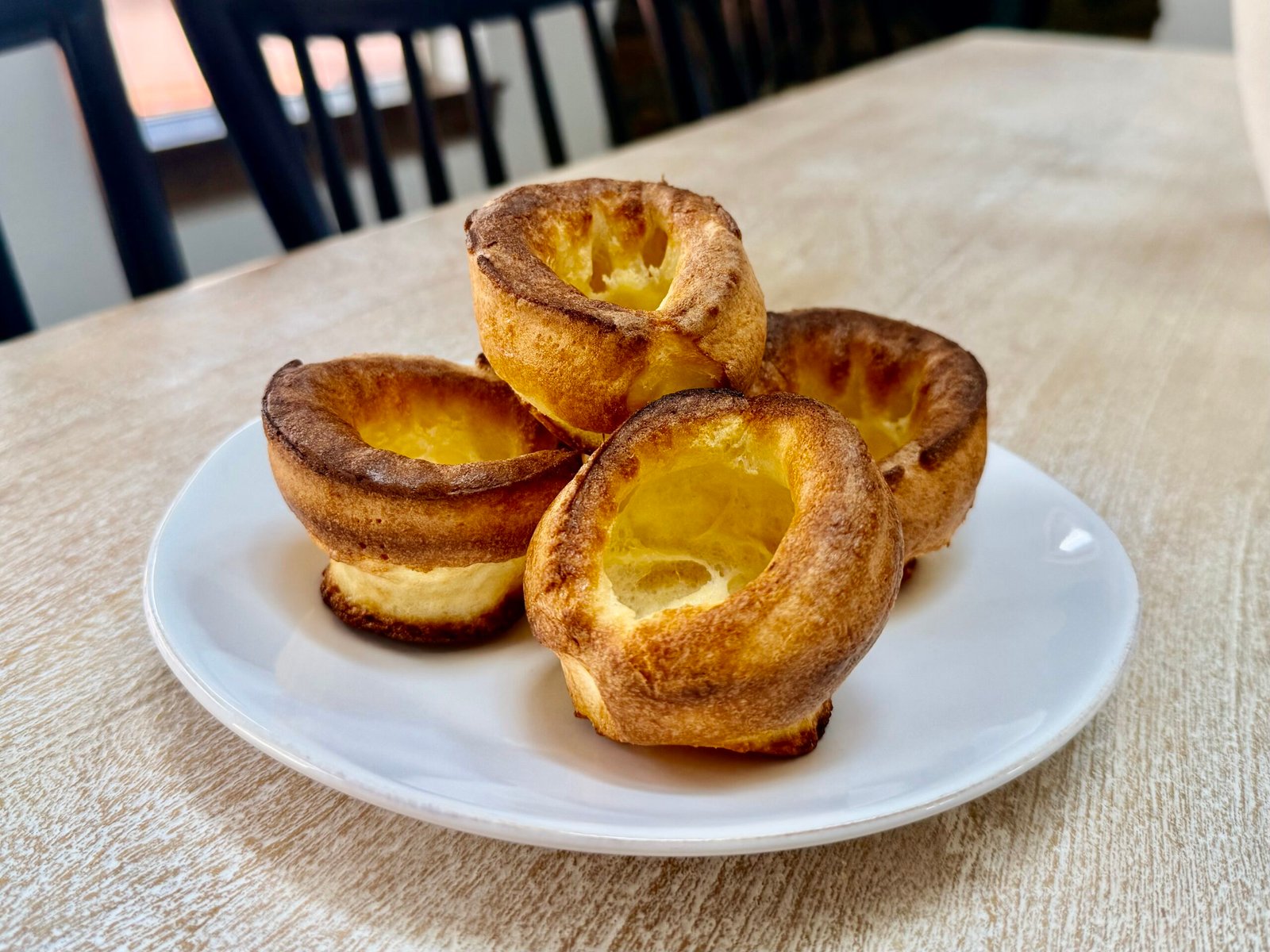
Yorkshire puddings should rise dramatically, with crisp golden edges and a light, airy, almost hollow center. That feels almost impossible when the altitude is working against you!
At around 8,600 feet, my early batches tasted fine, but they just weren’t right. They didn’t rise nearly enough. Instead of the light, hollow interior I was used to, I was getting a heavier, slightly doughy layer at the bottom.
That’s what led me to start testing a high-altitude version of my own.
Developing Yorkshire Puddings for High Altitude
I tried several variations before landing on this one. My first attempts were disappointing.
I even tried a sourdough version. They tasted good, but they were still too dense at the bottom and didn’t rise as much as I wanted.
Eventually, I went back to a more traditional Yorkshire pudding ratio, based on Mary Berry’s classic recipe. Her recipe used a much higher proportion of eggs than my early tests, which gave me a better starting point for my high-altitude version.
For me, the biggest improvements came from using more egg and liquid, adding a small amount of bread flour, and baking at a higher temperature.
That combination finally gave me Yorkshire puddings that were tall, crisp and properly hollow inside, ready to be filled with gravy.
Why I Use a Little Bread Flour
Traditional Yorkshire puddings are generally made with plain flour, which is similar to American all-purpose flour.
For this high-altitude version, I use mostly all-purpose flour with a small amount of bread flour.
I found that the extra structure helped support the rise without making the puddings heavy or chewy. It’s a small adjustment, but it made a noticeable difference in my kitchen.
What Makes a Good Yorkshire Pudding?
Growing up in Yorkshire, I have a pretty clear benchmark. A good Yorkshire pudding should be tall, crisp and golden on the outside, with a light, airy center and a deep hollow for gravy.
They don’t need to look perfectly uniform. In fact, the uneven peaks and deep hollows are part of what makes homemade Yorkshire puddings so good.
For me, the goal was simple: I wanted them to taste and feel like the ones from my mother’s and grandma’s kitchens. After several rounds of testing, these finally gave me the tall, crisp and hollow Yorkshire puddings I was looking for.
High-Altitude Yorkshire Puddings
Ingredients
Equipment
Method
- Preheat the oven to 450°F conventional. Place the empty 12-cup metal muffin tin in the oven while it preheats.
- Add the all-purpose flour, bread flour, and salt to a mixing bowl or large measuring jug and whisk together.
- Whisk the eggs and milk together in a separate bowl.
- Slowly pour the egg and milk mixture into the flour and salt mixture and whisk until you have a completely smooth, thin batter.
- Rest the batter for 20–30 minutes at room temperature. The finished batter should be very pourable, similar in consistency to thin crêpe batter or heavy cream.
- As the batter rests, carefully remove the hot muffin tin and add approximately 1 teaspoon oil to each cup. Return the tin to the oven for about 5–10 minutes, until the oil is very hot and shimmering.
- After the batter finishes resting, carefully remove or partially slide out the hot muffin tin. Working quickly, divide the batter evenly between all 12 cups. The batter should sizzle as soon as it hits the hot oil.
- Immediately return the tin to the oven and bake at 450°F for 18-20 minutes, or until the Yorkshire puddings are dramatically risen and golden brown.
- Remove from the oven and serve immediately.
Notes
- ⅔ cup all-purpose flour
- 3 tbsp bread flour
- 1 cup + 2 tbsp milk
Want more recipes like this?
Get new British-inspired recipes and high-altitude baking tips straight to your inbox.